Fusing Creativity with AI.
By Rob ClaytonShould we be afraid?

What the devil is AI?
Artificial Intelligence (AI) is a branch of computer science focused on creating systems that perform tasks requiring human intelligence, such as learning, reasoning, and language understanding. It includes narrow AI, like voice assistants (Siri, Alexa) and recommendation systems (Netflix, Amazon), and the theoretical general AI, which aims for human-like cognitive abilities. Key technologies include machine learning, neural networks, and deep learning. While AI advancements offer transformative potential, they also raise ethical concerns regarding job displacement, privacy, and decision-making transparency.
Not my words!
Yes, the introduction was indeed written by AI. This was the first attempt created by ChatGPT after giving it the prompt ‘Explain in a short paragraph - What is AI?’. The results (created in under 5 seconds) highlight the true power of AI, its real capabilities and ability to save time. With additional prompts and time invested in it, the paragraph could be refined to create the impact that is required.
It’s a clear and functional start to this article, but it is devoid of any true character or personality. The ‘human, personal connection’ is missing, which is often a by-product of our over reliance on technology. But AI will learn, grow and adapt from us and if I asked for the same request in a years time I am sure the result will be even more refined.
Putting AI into action.
We have all seen AI steadily creeping into our day to day world, from mind-blowing images to deep fakes; it has all become a bit of a challenge to identify what is real or not.
The one lesson we can all learn from AI is to question EVERYTHING. This is nothing new to a creative agency like Absolute though – we constantly have question everything and be forensic to help us form robust ideas that stand the test of time.
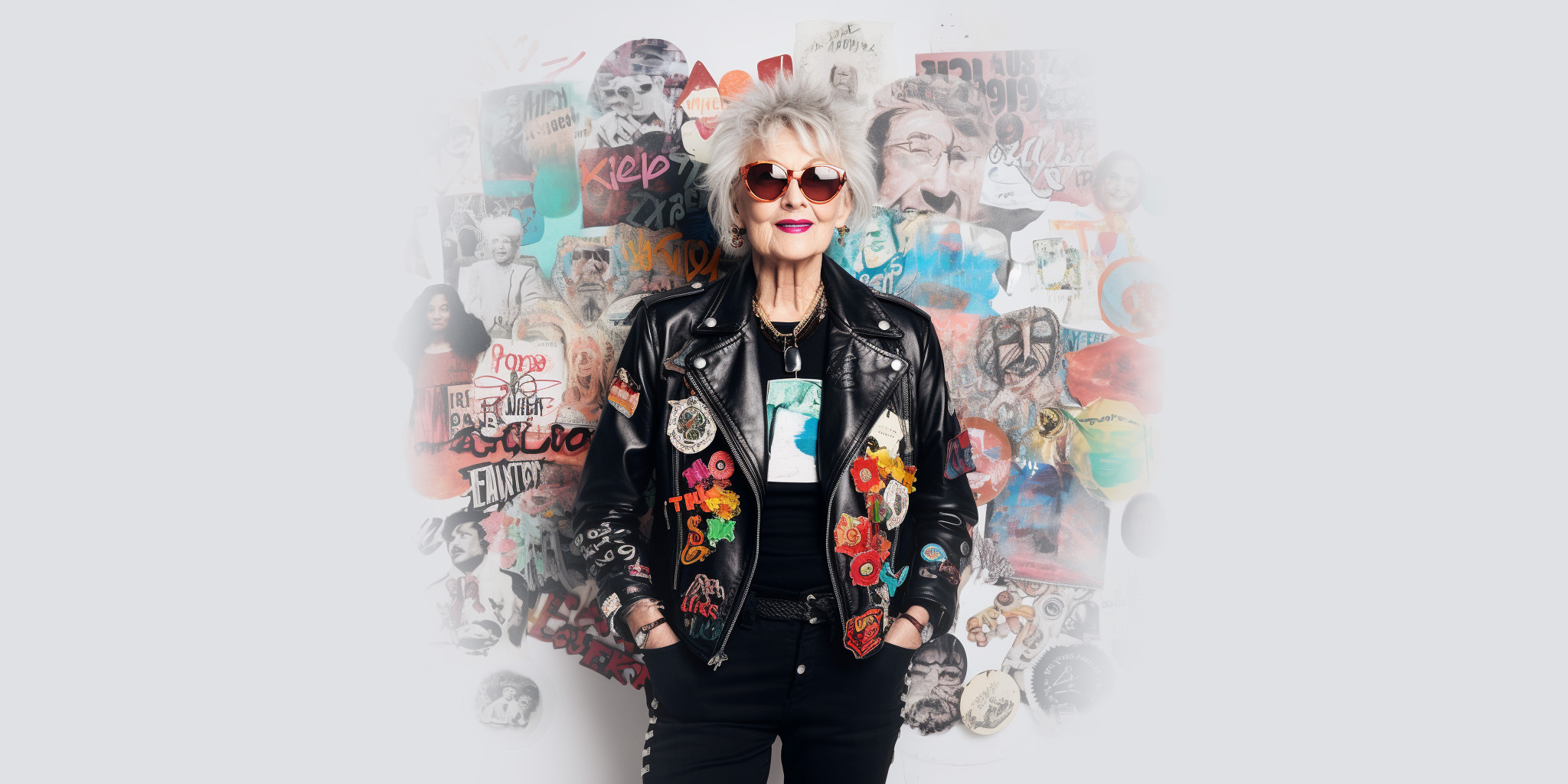
As an early foray into the world of AI, I wanted to see what it could create for a ‘live’ project currently in the studio. I (tried!) to harness the power of Midjourney (an image based AI generator) to create the effect I was after.
To achieve this, Midjourney has to be given a prompt that has to be succinct, ordered and methodical. The prompting and refinement process of AI is a skillset in itself though. One of which becomes easier the more you get to grips with the technology.
To create the image I gave Midjourney the following prompt:
/imagine prompt A portrait of a elderly woman stood at three quarter angle wearing a black leather jacket, thinking about at her life full of cherished memories and experiences, in a photography studio against a white background, the background contains a layered montage of memories and objects from her life, the objects emanating from behind her, joyful and colourful mood.
This may sound an awkward description, but this is the rough format for achieving what you need on Midjourney.
The Results.
For a first attempt the results are seriously impressive. The amount of variations you can render is infinite and the quality is good, with the scale and speed it creates images being truly extraordinary.
I constructed the initial prompt to be quite direct, with the background request purposely left open to interpretation. This is where AI seems to go a little wayward due to the personal nature of memories and their relevancy to the composition. Oddities and anomalies start to appear throughout every image as a result.
Generally though, the final output does not quite hit the nail on the head for two reasons:
- They final results lack the craft and quality only a human produce (at this stage!)
- The AI relies on a super concise human description to get the best results. And even then the results can be a little strange at times.
The technology is in its infancy and it will improve, learn and adapt over time. Without the creative human vision and input, it is slightly flawed currently. It also creates a sterile and often lifeless image that appears a little ‘off'. This may be due to the description needing expansion or further refinement and time required to achieve the initial vision.
As a concept tool to communicate an idea though, it is super impressive and efficient tool which will enhance any process.
Crafted with care.
To recreate the composition in real life, a photographer would be commissioned, models would be cast, and appropriate outfits chosen. The photographer would then capture the essence of the models character, guided by an art director to ensure the brief and vision are properly executed. This human-driven process allows for spontaneity, unseen moments, genuine expressions that elevate the creative work and give it a genuine look and feel.
Next, the background composition would be tailored to the individual, which may take a little bit more time to create than AI, but the composition will have content that is relevant, have balance and is considered in every detail. This is far away from the end product AI currently is capable of.
Should we be afraid?
The scope for being able to use AI as a creative tool is vast. From streamlining processes within agencies to being able to provide creative inspiration, the potential impact is undeniable.
It can be used as a tool for lateral thinking such as mood boards and concept visualisation to express the ideas created by human designers. But AI cannot replace the power of the human creative mind, vision, spontaneity and craft (presently).
While AI is a powerful tool, it cannot be solely relied upon. Over dependence on AI can lead to laziness, weak ideas, poor execution and negatively impacting the end result. Additionally, there are legal issues to consider when utilising AI as solution. If AI is used to create a concept for a client, the agency may not technically own the work due to the legal complexities surrounding where AI scrapes its data from. But should AI be used as the final solution then a whole world of issues may begin to pop up for agencies, clients and the creative industry.
This legal grey area can be avoided altogether in the ‘implement phase’ where an idea is brought to life in the real world. The creative process is defined and more importantly ‘human’ which helps create a true human connection - something that can be missing in our technology led world.
As an industry we should be utilising AI to speed up our processes and enhance our creative ideas. It's just another tool at our disposal and should be embraced to elevate our creativity. Overall though, AI is an exciting technology with vast potential that all creative agencies can benefit from.
Absolute will be filming an Absolute Talks podcast in August with experienced Ai specialist Nick Taylor. Nick is the CEO of New York based Quantum Flow Ai, who’s mission is to empower entrepreneurs and marketing teams to harness the transformative potential of Ai, ensuring that human creativity and ingenuity remain at their core.